Showing posts with label architectural iron. Show all posts

Wednesday, November 25, 2009

BCA steams into reuse

Above: Part of the 19th century railway sheds outside Paris


Paris France - DAVID Ackers of France's premier demolition and salvage company, B.C.A. Materiaux Anciens S.A., has today posted a gallery of images of a historic nineteenth century steam engine and railway goods shed complex on the outskirts of Paris for which BCA are seeking interest. Bruno Cottier, head of BCA, is hoping that this fabulous early reclaimed structural ironwork can be found a new home or homes where it will be reused, rather then being scrapped and sent for recycling. Contact BCA via their website for more info.

BCA architectural ironwork elements for sale

Photo gallery of the engine sheds

Tuesday, March 17, 2009

Mini stands


reuse of the week
These mini cake stands are ideal for Easter or for any afternoon tea

Chinasearch have introduced a range of eclectic and varied Mini Stands which have been created using small items from dinner or tea services. These mini-stands lend themselves to a variety of uses. Although Chinasearch has a large range of ready-made Mini Stands, others can be specially made to order.


Chinasearch

Wednesday, February 25, 2009

The sun shines for the Listed Property Show


Above: The Salvo stand at The Listed Property show promoting Salvo and the trade


Above: Ruby Kay and Terry Garrett on the Salvo stand speaking to visitors to the show in Olympia. We had a great response from everyone and people were extremely interested in Salvo and the trade and visitors to the show were particularly interested in the upcoming SalvoFAIR . . . so book your stands now!!!


Above: the Salvo stand showed display boards for Lassco, Architectural Forum, Westlands, Drummonds, Architectural Antiques, Architectural Heritage, IBS and Mongers


Above: Simon and Mark of Thomas Crapper put together their stand at the Listed Property Show. All of the trade reported a good fair and lots of interest from visitors.

LISTED PROPERTY SHOW ROUNDUP by TK

ATTENDANCE at the Listed Property Show seemed very good, and Salvo was happy to have a stand there this year, put together by Ruby Kay and Colleen Gowlett, and manned by them, new girl Terry Garrett, and me. Salvo also organised a Saturday night pub crawl ending in a meal attended by the trade which was a fairly jolly affair considering all the doom and gloom lambasting everyone every day in the press. Inevitably some of the crew went clubbing and next day tales of thigh-length boots with perspex f***me heels were overheard. There were a dozen or more stands from the trade at the show, and several dealer display boards on the Salvo stand, including one from Mongers advertising their clearance sale on 5th April.

Geoff Wilson from Wilson's Yard in Co Down dropped by the Salvo stand. "It's hard to find originals," he said, "especially in Ireland. England had the best buildings - and more of them to demolish." LPS exhibitor Damian Cronin discusses the price difference between repro and original restored radiators (a topic mentioned in the last Salvo Mag - see 'It ain't easy doing Reclaimed Radiators'). "A firm at the show is selling a new 4-section nine column under window Chinese repro rad for £290. John Bodrell sells them for £1,200." Andy Triplow, the radiator king (although Bodrell is the emperor) of The Old Radiator Co sells them for £560. "Look," said Andy Newton, of UK Architectural Antiques, afterwards, "it's all very well carping on about fair trade and Chinese rads. I used to restore old ones but I eventually gave up after the restored rads started weeping and customers complained." Well, yes maybe he has a point. Anyway even restored rads contain new Chinese brass fittings. "Door furniture is still doing ok," said Fez of MDS, "but panel doors have gone quiet. Is it the competition or just a drop off in activity? I don't know." He said he would try a SalvoWEB build-a-button just in case. Charles Brooking was in attendance and is still looking for a patron to secure the long term future of the collection. A major UK construction company might be interested, he said. Justin Miles-Booy from Arc was jolly as he recounted a story of an old school dealer from an old antique garden biz. "I bought this old wooden seat and botched it together thinking I might get a ton. Well an erudite dealer came and asked to buy it. Sure, I want £100, I said. He paid and then told me it was an exceedingly rare J P White. In fact so rare he had only ever seen an example in an old J P White trade catalogue. Ah well." Rob Thomas was on Dean Cannadine's stand, and floorlayer Thomas Mountford of ATM was on Bob Lovell's stand - both wanted a Salvo article doing. Bob has some fab reclaimed teak flooring - a sample panel was on his stand - from Asia with export certificate. He signed up as a Salvo Code dealer at the show. I asked Rob whether Ray Radnege was still doing strip-outs of timber from demolition, since we have had reports that demolition contractors cannot get rid of timber these days. "Yes," Rob said, "if anyone has a load of timber tell them to get in touch. We'll either take it down ourselves or buy it on the deck."

Many people popped on to the Salvo stand while I was manning it on Sunday, and I did a roaring trade in Salvo bits including the free London & Region Salvo guide. Mrs Posh from Wiltshire saw LASSCO's display board showing Brunswick House at Vauxhall. "Is the house open to the public?" she asked. She seemed uninterested in visiting the Three Pigeons. "I shall call in next time I am in town," she affirmed. "The last time I tried to get in it was owned by a strange society." Yes, that's LASSCO, I mused. Two interior designers from Suffolk took a couple of Salvo Fair postcards. "We'll definitely be there for the trade day," one said. A lawyer asked, "What powers do conservation officers actually have?" "Last time I heard," I said, "their legal powers were defined by the 1990 Planning Act. Although I think it might have been updated now. Challenge anyone who says you can't use old materials," I offered. "I live in one of the Brockwell Park estate houses, and it has metal lined shutters. Do you know why that might be?" asked an elderly lady. "Brockwell Hall (built in 1813 by John Blades, a 78 year old Ludgate Hill glass merchant) also has them," she said. "Anti-theft? Anti-fire? Security device?" I suggested hopefully. There was a stand opposite hosted by Conservation Officers but they mainly seemed occupied with earnest-looking period house owners seeking advice, so we got the quickfire questions on our stand.

I spoke to Peter Anslow, the fair organiser, and asked if he was thinking of expanding it next year and suggested that more trade might come, with maybe more selling stands like Olliffs, who seemed to be busy, helped by Ronnie Wootton at times. Sam Olliff also kindly manned the Salvo stand for ten minutes on Sunday.

Good to see everyone, and perhaps we will be reconvening there again next year.

TK

Listed Property Show

Wednesday, June 18, 2008

A new book about John Hardman & Co


Hardman of Birmingham is the first in-depth study of John Hardman & Co, over the whole period of history. Michael Fisher, who is the firms archivist and a recognised authority on the work of A.W.N Pugin, has based this study upon his researches into the extensive Hardman records held in the Birmingham City archives, the Birmingham Museum & Art Gallery, and in private collection.

Neil Phillips, of John Hardman & Co will be attending the Salvo fair 2008 and bringing with him some of the books and hopefully its author to sign copies and chat about his interesting finds.

Monday, April 28, 2008

Future annual event at Architectural Treasures and Old Rad Co?


Above: Some of the new yard near Tenterden


St Michael's, Kent UK - SATURDAY 26th April was the opening day of Fiona and Andy Triplow's new six acre site on the A28, to where Architectural Treasures and The Old Radiator Company have now relocated, after countless truckloads of stock and equipment had been moved from sundry smaller depots and workshops dotted around east Kent.

Although the trade turn out was small, those that made it along with many members of the Kent salvage-buying public, received a hospitable welcome which featured guided tours, a local acoustic jazz band and hog roast in pleasantly sunny weather. In the evening the open day became a more private party with live rock n roll music, and cameo appearances by members of the trade including Steve Tomlin and Debbie Kedge who we believe travelled furthest.

This is the second grand opening held by Fiona and Andy - their first was at Smarden a couple of years ago - and later that night, over apple pie and ice cream (a traditional Irish snack) the possibility of an annual event was discussed, which would be a local shindig for their businesses with an opportunity for a Kent and region trade get together in the evening. If they decide to set a date, Salvo will include it on the wallplanner for next year.

Andy Triplow is the uncrowned king of reclaimed radiator stockists, with approximately 3,500 normally in stock, which he restores in-house and sells both privately and to the trade, mainly in the UK.

Architectural Treasures
The Old Radiator Company

Tuesday, January 22, 2008

La Fontaine de Tourny

Quebec city, Canada


Above: The Fontaine de Tourny installed in Quebec


Above: Marc and Daisy beside the Fountaine de Tourny


La Fontaine de Tourny was made by the French sculptor Mathurin Moreau and cast in 1850 by the Val d'Osne foundry. It was one of a pair that stood in the French city of Bordeaux. In 2007 it was shipped to Quebec from Paris and stored on lle d'Orleans, where specialist crafts people restored and refurbished it. The fountain was purchased from Marc and Daisy Maison, former Salvo Code dealers based in Parisa, as a gift to the city to celebrate its 400th anniversary, by Quebec fashion retailer La Maison Simons. The restored fountain was opened by the Prime Minister

Fountaine de Tourny

Wednesday, January 09, 2008

Any old Iron

Pure iron is starting to prove itself as an alternative to wrought iron and mild steel on restoration projects up and down the UK. TV DIYer Don said that "Iron is the most stable and one of the most plentiful elements in the universe. There is a perception within restoration circles that damaged wrought ironwork should be replaced like for like but new wrought iron is no longer made and pure iron offers a long lasting solution that is just as aesthetically pleasing and doesn't spilt, crack or break up like wrought iron." The lack of high quality wrought iron available to blacksmiths has led to many utilising a poorer quality product. Convention has played a part in its establishment but the lessons have not been learnt with increasing amounts of wrought ironwork requiring preservation or replacement.

Barbara a specialist web resource and professional blacksmith said that " working with pure iron is becoming increasingly popular as a sideline for many as it is easier to forge than existing metals and repousse work can be carried out cold. I have carried out a range of demanding comparisons in its performance to that of wrought iron and mild steel and it came out on top in many areas. all of the processes were executed with ease and no problems were encountered. With continuous hot bending the material showed no sign of cracking that would have occurred with mild steel had it been subjected to the same treatment."

Blacksmith Hector Cole said "for smiths who have tried forging wrought iron of poor quality and have encountered all its faults, pure iron will be a good substitute as its forging qualities are far superior to mild steel." Wrought Iron was was graded in four distinct quality and strength levels with the best performing grade A used for railway tracks for example. Grade D, the lowest grade, was introduced in 1959 specifically 'for fencing' and is often the source of the poor quality reclaimed material marketed to blacksmiths today. It is in the realm of ecclesiastical architecture that pure iron is increasingly proving its worth. one example is the gate installed recently at All Souls Church on the edge of Halifax town center in West Yorkshire.

reFURB

Tuesday, December 11, 2007

Radiators

CAST IRON RADIATORS are a perfect feature for a period home particularly this time of year. These units are either wall hung or stand on their own feet. Exposure to harsh winters and hot summers can potentially be damaging for ironwork and rust can appear, so regular maintenance and upkeep is essential. The best way to do this is with a good brush down and a fresh lick of paint. Although painting is a great prevention for rust and damage, a painted surface can mask splits and cracks, so care should be taken when buying reclaimed metal work. The first step in the cleaning process is to make sure that the ironwork is clean and dry and free from rust. Various grades of sandpaper, wire brushes, flame cleaning can be used to remove rust and old loose paint. Most paint systems for iron require a primer, undercoat and top coat but some are designed to do it all in one coat. Either way, paint is undeniably the best protection and it should be renewed every 3 to 5 years. Colour is important and black is renowned to be the most popular for gates, railings and most exterior ironwork. However, it was not until the death of Price Albert in 1861 that black became popular , before this red, green and blue were all colours of choice. This was probably due to the more vibrant colours were more expensive to mix and were therefore used as a status symbol.

OLD WROUGHT IRON Dating back centuries, old wrought iron is highly prized for its fibrous and malleable structure. the original blacksmith's material can be hammered and beaten when hot and twisted and bent when cold. Its knobbly surface and non-uniform appearance sets it apart from cast iron and steels more uniform and smooth surface. Unfortunately, old wrought ironwork is no longer widely available, being so labour intensive to produce but many skilled blacksmiths and foundries still exist and produce beautifully decorative wrought ironwork.

CAST IRON, as its name suggests, it is formed by pouring molten metal into a mould or 'cast'. Although cast iron is not easily worked like old wrought iron, it can be successfully welded or machined. Cast iron is the traditional choice for rainwater goods and can still be seen on many Georgian, Victorian and Edwardian properties today. It was also a popular choice for larger items such as railings and gates, being cheaper and quicker to produce than wrought iron. properly cared for, it will last for centuries but its main drawback is its brittleness and risk of shattering.

MODERN WROUGHT STEEL This refined form of iron can be worked when hot or cold and is often used as an alternative to wrought iron. It wasn't produced in large quantities until the middle of the 19th century, but today has largely replaced old wrought iron and many examples will be seen around the home today.


Period House

Tuesday, October 09, 2007

Period architectural features workshops autumn 2007

Greenwich, London UK

* Windows 1: 17th Century, Georgian and Regency 5 Oct 9 Nov
* Windows 2: Victorian, Edwardian and Interwar 12 Oct 16 Nov
* Doors: 16th Century to Early 20th century 19 Oct 23 Nov
* Cast Iron: 18th and 19th century 26 Oct 30 Dec
* Staircases: Late 17th century, to Interwar 2 Nov 7Dec

These workshops are designed to have a maximum of 10 participants and give an understanding of historic evolution of the window, door, staircase and cast iron features in British architecture. They can be booked as individual workshops at £50 per workshop or as a full series of five for £200 exclusive of VAT.

The workshops take place at the Martine Campus of the University of Greenwich. The teaching provided by the collection's founder Charles Brooking, will be accompanied by "handling sessions".

For further information please contact Jenny Lynch, School of Architecture and Construction at the University of Greenwich, telephone 020 8331 9312

Friday, October 05, 2007

Humberts sale of Extreme Architecture at Hurst Farm


Chilham, Caterbury UK Thursday 27th & Friday 28th September 2007

Up a windy path in the middle of nowhere in the pouring rain was the setting of the iconic sale of the entire stock of architectural salvage, restoration material, garden statuary, stoneware etc of Extreme Architecture.com together with the antiques and decorative furniture and effects from the residential property of Hurst Farm.

Everything had a price tag including the seats inside the marquee, the auctioneer motored through the 1249 lots, whilst the punters like vultures quickly snapped up each piece. Particular highlights included the Temple Bar Lodge which was once the main entrance into London and designed by Sir Christopher Wren. This sold for £26,000 to a UK private. The Royal Box at Ascot remained unsold, however the advertising created from this packed sale will perhaps help to sell it shortly. Dennis Buggins has already booked his stand for next year's Salvo fair to which he is planning to bring the Royal box and the Lloyd's Portico.


Above: Hurst Farm, selected bricks and tiles for auction


Above: The Lloyd's of London portico, an impressive Portland stone portico carved with the Lutine bell

Saturday, May 12, 2007

May auctions and fairs

UK - THOS Wm Gaze & Sons in Diss, Norfolk, sale of architectural salvage and statuary will be held at 10am on 19th May, run by expert in charge Carl Willows, and this time round has a fine Arts & Crafts oak porch (est £200) among the 1,000 or so lots.

Sotheby's Billingshurst is apparently going to be turned into luxury flats and houses but before that it will host a spring sale on 22nd May of antique garden ornament, fossils and modern sculpture, and this time four olive trees in wood planters (est £4k).

Christie's South Kensington's Toby Woolley will sell a load of garden and architectural items collected by Mike Roberts on 23rd May, including terracotta, statuary, a large number of lanterns, and several fireplaces. The top ranked lot is a pair of Coade ovoid urn finials (est £20k).

Drewette Neate have a garden section at the Csaky house sale in Stockbridge, Hampshire, on 22nd May. Fleury Antiques, who have had a year's worth of sales, are now advertising a clearance sale on 15th and 16th May in Cahir, Co Tipperary, of decorative antiques probably including some architectural and garden. David Erquhart of Posterity in Herefordshire is having his annual auction on 20th May at 12.30pm. Watsons in Heathfield, East Sussex is holding a 500 lot sale of garden and architectural salvage and repro on 18th May. As if this is not enough, Swinderby is on 29th and 30th May, followed by Newark on 31st May and 1st June.

Sotheby's Amsterdam will be holding its annual (is it annual?) Piet Jonkers sale of antique garden ornament on 30th May. Described in the catalogue as 'The Piet Jonker Collection' as if it were the disposal of a lifetime's gathering up of antiques, the sale is a preferred way of trading for an antique dealer. These types of sale are becoming more common, as in 'The Property of Michael Roberts' at Christie's above, so perhaps it would be fairer if their periodicity, and the regular relationship between auction house and dealer were noted somewhere in the catalogue, in case someone not in the know obtained the wrong impression. Would it be fairer to call them a 'Dealer Sale'? That may make them sound slightly downmarket and mercenary which could put off high-spending customers. The trouble is that 'dealer sale' is also used to describe a sale at a trade fair for the benefit of dealers.

After a long absence (who knows what happened to Kevin Scott) Bonhams have decided to hold a garden sale on 6th June and an architectural sale on 21st July in Henley.

Chelsea Flower Show is being held from 22nd to 26th May and will feature, among others no doubt, Mike Corbett of Triton UK's collection of unique and replica garden ornament, Ed Holloway unrolling the agos range, Alex Puddy with the antique and new garden ornament of Architectural Heritage, Bulbeck and H. Crowther. Not sure if Hughie Powell and Cotswold Decorative Ironwork will be there this year.

Last but not least, LASSCO Three Pigeons is holding a dealer swap shop sponsored by TVADA but open to all-comers in the car park of its new ex-pub premises at Milton Common in Oxfordshire on Friday 18th May from 12pm to 3pm.

Brief reports or photos (please ask permission) would be appreciated of all events listed if anyone can be bothered.

Gaze auctions and other paying advertisers are listed on the
Salvo Auction & Event Calendar

Sunday, November 26, 2006

Reclamation Protocol Part 2

London UK - Part Two follows Part 1 (below) and was a summary of a fuller version printed in the journal Salvo Monthly, April & May 1995


A RECLAMATION PROTOCOL by Thornton Kay of SALVO in 1995

Many building materials are being reclaimed throughout the world, but in Europe and North America, much more could be done. In these environment-conscious times we believe that more is being trashed in richer countries than ever before. This would seem to suggest that reclamation is not as successful as it should be due to the consumer ethic that "new is best". The main reason for this is not lack of interest from consumers, who are showing an increasing willingness to buy reclaimed material, but ignorance of the market and an unhelpful attitude on the part of producers of new materials who are understandably reluctant to relinquish market share.

There are limits to the total amount of material available to be reclaimed and these limits are determined by many factors, the most important of which is the primary supply from the demolition industry of components from whole buildings and the abundant amounts placed in skips from smaller demolitions during the course of alteration and repair works. If every scrap of material available were to be reclaimed, about 30,000 tons a day in Britain, we reckon that this would still only provide reclaimed alternatives to fulfil around 5% to 10% of the total building materials market. At present we reckon that less than 1% is currently sourced from reclaimed material, and it is this small, but significant, loss of material taken to landfill sites for which we are trying to encourage a market. The majority of this material is in the form of bulk items such as timber, bricks and masonry. However, much is still lost in the form of Victorian fixtures and fittings, early 20th century features, and incredibly we still hear all too often of very valuable features, such as, in February 1995, a carved marble Georgian fire surround from Edinburgh's New Town district in a skip going to landfill.

The recycling protocol that was embodied in the sustainability clause - known as Agenda 21 - at the 1992 Rio Earth Summit gives priority to the preservation of energy content when reusing resources. Broadly speaking it states that if it takes more energy to reuse an item than it does to make a new one, then in energy terms it is better to make a new one and throw the old one away. This relates directly to the voluntary efforts being made to reduce the amount of fossil fuel expended on producing new materials, thereby reducing carbon dioxide emissions and so reducing global warming. The reasons for wanting to reduce global warming are primarily that future generations will have to cope with the considerable extra financial burden of minimising the effects of climate change, not least of which will be rising sea and river levels, which will require reduction in land mass or the expense of increased flood protection schemes. However, this is only part of the equation.

Agenda 21 also gives priority to preserving resources and respecting cultural identity. This does not have a simple formula, like the energy example above. How do you value resources such as old mahogany against new Iroko, or 300 year old Sitka spruce against 30 year old plantation Sitka? Many of the old indigenous timber species are known to be more durable, but there is no formula for making a comparison with plantation species. The environmental damage caused by forestry methods is now becoming known as a contributor to soil erosion and acid lakes and rivers. There is no formula to make comparisons between old and new timber but logic would say that it is sensible to reclaim timber rather than destroy it. It is also true that timber disposed of in unmanaged landfill will generate methane which is a greenhouse gas. As mentioned above, reclaimed timber will never replace the demand for new timber but it could reduce it by 5% to 10%, and so help preserve forests, which in turn will allow the greater use of these forests as habitat for wildlife and people. If timber is not demolished in large enough sections to be reusable, then it is possible to recycle smaller pieces. An Austrian firm is attempting to manufacture blockboard using recycled timber. If after attempts to reclaim or recycle prove impossible, then the timber should be used to provide fuel. All demolished construction materials have similar patterns of reuse opportunities, but the simple energy-based criteria is not the only one. Even energy formulae are difficult to produce. For instance, do you take the energy costs of felling wood, transporting it and converting it, do you add the energy involved to make the logging machinery, and house and transport logging workers?

The traditional manufacture of construction materials often overlap with, or even rely on, reclamation and recycling. For example, in Britain the Campaign for Real Iron is attempting to prevent the early 19th century charcoal-made wrought iron panels of early iron structures from being scrapped alongside modern mild steel, and melted down to make into new steel products. Charcoal-made wrought iron is impossible to manufacture in Britain, so as a resource it is invaluable if, like Yorkshire blacksmith Chris Topp, you make wrought iron railings with blown leaf scrolls and appreciate the difference. Outside Agenda 21, although remaining inside the Rio cultural protocol, a case can be made that old buildings and architectural items form part of the history of a culture, and so should be preserved for re-use. Even though something of the original integrity of an architectural item may be lost if that item is reused out of context, we believe that it is better used out of context than placed in landfill. Many examples exist where items rescued in the past and reused out of context, have been subsequently repatriated in their historically or architecturally correct setting at a later date. Ordinary people tend to appreciate the efforts made, although the current fashion in Britain is dictated by a small minority of historical architecture fundamentalists (which include the leading lights of Britains' conservation organisations) who would rather see both demolished buildings, and all the materials they contain, continue to be landfilled. Salvo has devised a recycling protocol with respect to the built environment that gives the following priority list for what to do with old architectural items:

1. Re-use a building without demolition or alteration. If this is not possible then:-
2. Reclaim components in as intact a way as possible. Relocate entire buildings, Reuse facades and structural elements, Reclaim whole features such as windows with their surrounds, shutters, and window furniture. Finally dismantle and Reclaim the individual items that were used to assemble a building. We define Architectural Antiques as manufactured items usually with a degree of skilled labour involved, such as carved items, doors and fireplaces, and Reclaimed Building Materials as the basic building components such as bricks and timber beams. If reclamation is not possible then:-
3. Recycle and remanufacture a new product. Reclaimed wood can be recycled to make furniture, floorboards or even blockboard. Concrete can be crushed to make recycled aggregate. Plastics can be remanufactured into new plastics products like polythene bags. If recycling is not an option then:-
4. Beneficially Destroy with energy recovery. Scrap wood and other carbon-based products can be used to fuel power plants, or for local heating or cooking. Methane can be recovered from landfill sites where carbon-based demolition waste has been tipped.

All political parties should adopt this sensible protocol in environmental policy documents on demolition waste - Reuse, Reclaim, Recycle, Destroy. This would at least create the correct theoretical background against which targeted effort and practical measures can be applied.

The UK Planning Acts have produced a planning process that creates an emotive link between local public opinion and old buildings. The concept of reusing buildings or their components again, or relocating whole buildings, does not enter into that process. Thus the local community is encouraged to believe it faces a stark choice - save intact or destroy completely. A sensible approach would be to offer a compromise - save some intact, relocate the historically important, reclaim the rest for local reuse, don't destroy anything. The old PPG15 (Planning Policy Guidance note - used by Local Authorities to interpret the Planning Acts) encouraged planners to make rarely-used conditions on demolition requiring that demolished material be reused. The latest PPG dropped these suggestions, for which the DoE said there was no room in the White Paper - which was not true, and merely pandered to the SPAB element of English Heritage. Conservationists prefer the stark choice believing that this concentrates peoples' minds and saves more buildings. This is not borne out by the facts. Even listed buildings are demolished in whole or part, and hundreds of thousands of historic unlisted buildings are demolished every year. The planning process itself also encourage eventual rapid demolition. Vandalism and theft occur as a result of buildings being left empty for years while planning disputes are resolved. During this period millions of tonnes of reclaimable materials are lost to fire and water-damage. Old buildings should never be allowed to remain unoccupied, it should be illegal. Instead, more buildings are now left unoccupied and boarded up pending their future than ever before.

Some local authorities' building control departments refuse to allow the reuse of reclaimed material. The most common reasons are that reclaimed materials contain dry rot, even if they are sound, or that reclaimed materials do not comply with modern standards. The dry rot brigade are wilfully ignorant since the spores exist in the air permanently so even brand new materials contain dry rot spores. Dry rot is created by environmental conditions that are independent of materials. Equally, planning and conservation departments have been known to refuse to allow the reuse of reclaimed materials in works requiring planning permission or listed building consents because they say that it encourages theft and demolition, and confuses the history of a building. Although theft is a problem, particularly of garden ornaments, the volume of materials stolen is small, and invariably results from the deliberate policies that allow buildings to remain empty for long periods of time. Those who believe that reclamation encourages demolition are even further down the track of complete insanity. With respect to confusing history, most buildings have changed and adapted over the years, many using old materials, or materials reused from one part of the building in another. If such policies require that materials, like a Louis XVI marble fireplace, can only be installed in an unlisted 1930s' semi, it makes a mockery of freedom of choice and good architectural sense.

The establishment of reclamation businesses is discouraged in the UK by planners, who see them as non-conforming undesirable businesses. In some areas they have ceased trading after planners have picked on them. This is despite the recycling commitment given by John Major in signing the Rio Accord. There is a glimmer of hope since the DoE planning inspectors who are called in at appeals seem to have a more sympathetic approach. We suspect that Conservation Officers have a hand in influencing decisions on local reclamation yards' planning problems. A well respected conservation-aware Midlands reclamation dealer was refused entry to an ACO sponsored conference (Association of Conservation Officers) solely on the grounds that he was a reclaimed building materials dealer. More or less every reclamation dealer has had problems with planners. What should happen is that planners should encourage reclamation, councils should earmark land and premises, conservation officers should require demolished materials to be sold to reclamation rather than landfilled, and local municipal, education, and health authorities should develop reclamation-only policies for all their demolished buildings and for a percentage (say 5%) of the procurement of construction materials. Partnership arrangements should be made between reclamation dealers and local authorities to save materials for local reuse. This could all be achieved voluntarily.

The new EC Construction Products Directive sets out to ban the sale of reclaimed materials if they are not manufactured to current euro-standards. Which, of course, they are not. Even if they were, it is no longer possible to prove since most materials are older than 75 years and detailed records of the manufacturing processes are not available. Even if they were, the quality control procedures would not have been recorded in the correct way to comply with modern standards. The Directive says that if you can't prove reclaimed materials (and they mean every single brick) comply with the standards then they must be substandard and therefore illegal. Our visit to Brussels, and meeting with Carl Heinz Zachmann, the Head of the Construction Directorate (DG12), made it absolutely clear that reclaimed materials were considered substandard, and would be banned. Even if the bureaucrats were sympathetic, legislation in Europe is dominated by small lobbies of powerful vested interests, who dictate the commercial agenda. I was told that environmental logic is of no importance in Brussels. Power talks.

A committee has been meeting to discuss an EU Demolition Waste Strategy which will inevitably lead to a Directive requiring national targets to be set for the recycling of demolition waste. From what we can glean, plans are at an advanced stage for this Directive. It will not follow the EC's own Recycling Protocol but will give any of the four recycling methods (Reuse, Reclamation, Recycling, Beneficial Destruction) equal merit. The drafting committee is being led by Germany and Denmark whose expertise in the field of reclamation is very weak and who appear to have a pathological dread of using old materials unless they have been remanufactured into something new. German federal recycling laws require that all demolition waste is separated and recycled. Specially licensed demolition contractors are paid additional money for recycling costs. But bricks are crushed and no reclamation takes place. Fly-tipping, illegal burning and the illegal export of demolition waste to neighbouring countries is common. We suspect that commercial and political pressures will result in the UK acquiescing to a proposed Demolition Waste Directive and that this will damage the UK, French, Belgian and southern European reclamation industries by encouraging recycling over reclamation. A target-driven directive will result in more capital intensive recycling, and less employment extensive reclamation. After the Directive is passed, the only recourse for the Reclamation Industry and its customers will be to break the law.

Visit the Salvo website at www.salvo.co.uk.

T Kay 1995

Thursday, November 02, 2006

Salander in New York

Coade stone royal armorial lion impressed COADE, LONDON, 1820. [Photo Salander Decorative Arts

New York USA - Christie's auction of the stock of Mike Roberts' Architectural Emporium in Kent, England, in September 2004 raised an unexpectedly large total, buoyed up by enthusiastic bidding from abroad. It now seems that much of it has ended up at the world's newest plush salvage and antique architectural and garden ornament showroom, the newly created Salander Decorative Arts in New York. Lawrence Salander, fourth generation dealer, is a significant figure in the top end of the trade. Salander O'Reilly sells antique and modern flat art and sculpture, representing living artists, estates, and sponsoring museum-quality exhibitions and books.

Artnet quotes the New York Times, 26 October 2006, commenting on plans restore an old gallery and to build a new glass tower block alongside, the gives an idea of Salander's connections:
'As art collector and superdeveloper Aby Rosen brings his plans for a new luxury residential tower at 980 Madison Avenue, designed by star architect Norman Foster and located across the street from the Carlyle Hotel and a few blocks up from the Whitney, before the local community and landmarks panels, the New York Times notes that the art-world A list has stepped up to testify on his behalf. Among them are artists Jeff Koons and dealers Larry Gagosian and Lawrence Salander, according to the paper. Whether that will get the project approved for the notoriously anti-development Upper East Side remains to be seen. In any case, the Times also noted that it was Rosen who paid $2.7 million for Koons’ Buster Keaton sculpture at auction last spring.'

And the New York Times goes further:
'“I believe the project will be a godsend to the neighborhood,” Mr. Salander said. “I would trust your motives and artistic sensibility to do the right thing and without reservation.” But Ward Blum, an East 77th Street resident, said that adding the glass tower to Madison Avenue would be “like the Philharmonic inviting a heavy-metal punk rocker to join the orchestra.” Mr. Rosen said his enthusiasm for architecture dated from his childhood in Frankfurt. “I always loved the prewar,” he said. “I always loved the high ceilings, I always loved the stucco and the moldings.” It isn’t easy to hear people attack him, Mr. Rosen says. But the anti-Semitism he experienced as a Jewish child in Germany helps give him perspective. “I grew up with kids telling me, ‘They forgot to gas your father,’ ” he said. “So I have zero fear. Fear is not something I have.”'

Saturday, June 10, 2006

SalvoFAIR: Events and workshops


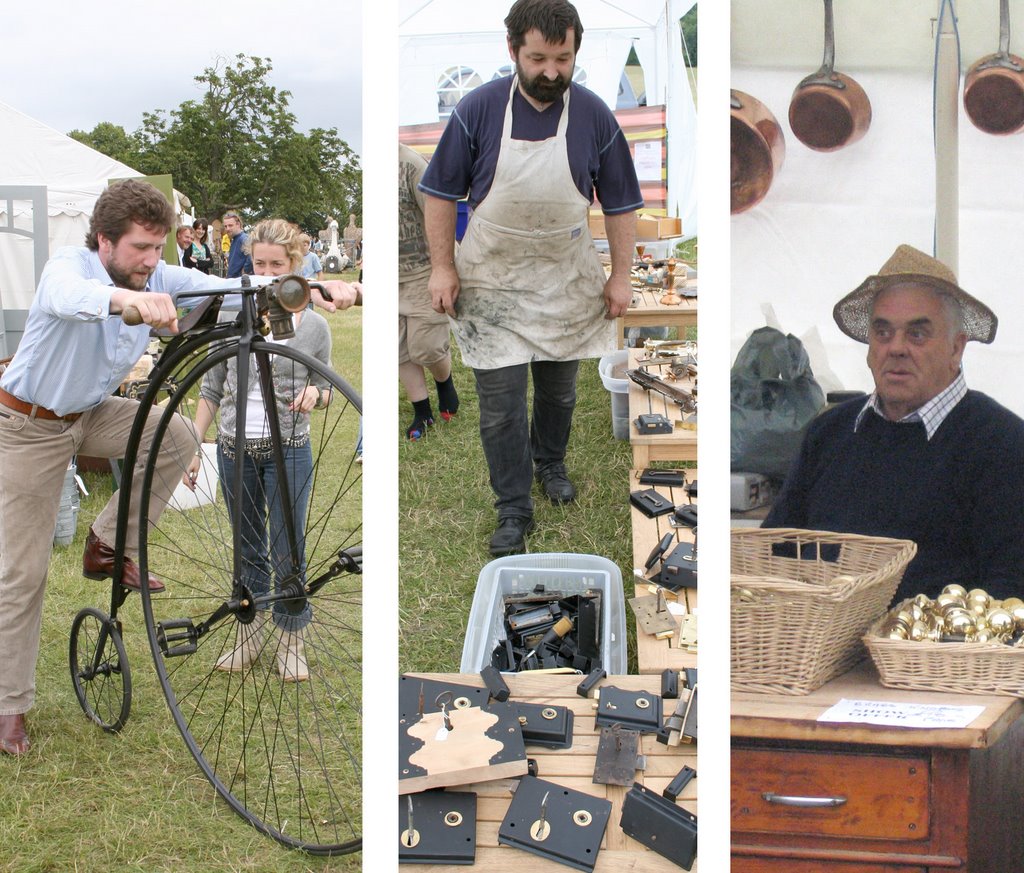
Photo: At Salvo 2005 Simon Kirby of Thomas Crapper & Co gave penny farthing rides, Michael Brown of Lock Restoration Co made antique keys while-u-wait, and Ronnie Wootton of MDS Ltd looked implacable as the world reflex champion. This year there will be more talks, and both Simon and Ronnie are prepared to take on all-comers [Photo 2005 © Salvo


Hertfordshire, UK - This year's Salvo Fair at Knebworth will include workshops, demonstrations and talks by the trade. Here are some examples:

Sanitaryware by Norman Cockroft of Alscot Bathrooms on the stand of Thomas Crapper & Co - How to clean stained baths bogs and basins, and when to call in the professionals.

Old cast iron radiators by Andy Triplow of the Old Radiator Company, Kent - How to clean them, test them and adapt them to modern heating systems.

Old English Rose & Paul kitchens by Tom Donaldson of Source, Somerset - Making 1950's aluminium kitchens fit for the modern home.

Antique keys and locks by Michael Brown of Lock Restoration Co, Strathclyde - How locks work, maintaining your old locks, repairs and keymaking.

Stained glass and leaded lights by Edgar Phillips of the Stained Glass Group, West Midlands - How to seal leaky windows, painting and firing, making hangers 'while-u-wait'.

Penny Farthing racing by Simon Kirby of Thomas Crapper & Co, Warwickshire - Mr. Kirby will take on all-comers. Probably late afternoon when the field is quieter. Contenders must bring their own penny farthing.

Traditional beam hewing by Wocko The Woodman of Knebworth - Slow but steady oak and chestnut beam hewing workshops, lasting all day between well-earned rests.

Reflex Reaction Challenge by Ronnie Wootton of MDS Ltd, West Midlands - Mr. Wootton, World Champion, who beat the Parachute Regiment at Malvern Show, will take on all-comers.

The Square Mile Project by James Rylands of Sotheby's on the stand of Extreme Architecture from Kent - The successful sale of the Baltic Exchange and other buildings like it is vital if more is to be saved. Dennis Buggins of Extreme Architecture will be there and is bringing parts of these buildings. Overseas and top-end dealers are welcome to the talk on Friday morning, and all construction professionals to the talk on Friday afternoon.

If you are planning to have a stand at the fair and have an idea for an event please contact Thornton Kay of Salvo. Tel 020 8400 6222. See the Salvo Fair web site.

Featured

Drummond Shaw interviewed in 2008

Hindhead, Surrey UK - DRUMMOND Shaw of Drummonds Architectural is interviewed by Thornton Kay of Salvo in the back yard of his Hindhead, Su...