Showing posts with label antique windows. Show all posts

Monday, March 15, 2010

Reclaimed French windows on BCA's gallery


Maine-et-Loire, France
BCA have uploaded some cast and wrought iron French windows on to their gallery. To view the windows follow the link below. . .


BCA gallery

Monday, January 18, 2010

Tiffany window will be sold to fund homeless shelter

Boston, MA USA

A dwindling church congregation has voted to sell its valuable, stained-glass Tiffany window so it can keep its homeless shelter open. In November, the membership of the First Baptist Church in Brattleboro, Vermont voted 20 to four to sell the Tiffany work, which depicts St John the Divine, and is signed by Tiffany Studios.


The Art Newspaper

Tuesday, January 05, 2010

Sash windows are not so bad after all

New scientific evidence is available from the English Heritage to counteract some of the misconceptions about the energy efficiency of original sash windows. Recent findings have shown that with simple repairs and basic improvements significant reductions of draughts and heat loss can easily be achieved.

Key findings have shown that Simple repairs to mend cracks and eliminate gaps can significantly reduce the amount of air infiltration or draughts by around one third. Also, adding draught proofing can reduce air infiltration by 86%. More elaborate measures reduce heat loss even more and can improve windows to meet modern Building Regulations, which target a U value for windows of 2 or below.

Dr Simon Thurley, Chief Executive of English Heritage, said: “It is very encouraging to see that more buildings are being refurbished to meet modern energy requirements, but all too often a drastic and insensitive approach has led to the degradation of our streetscapes . Many original timber sash windows have lasted more than two hundred years and are capable of lasting another century. This piece of research provides the hard evidence that shows how easy it is to upgrade them and supports our call for their retention.”


English Heritage

Wednesday, October 07, 2009

Church salvage and the law

Some aspects of the law on dealing in architectural salvage, antiques and artefacts from churches by Thornton Kay

See the complete article 'Church salvage' and all the reference documents here

Removing antique, reclaimed and salvaged items from churches in England and Wales is governed by the 1990 Planning Act and the Ecclesiastical Exemption order of 1997.

Ecclesiastical exemption for the six named denominations covers works to a listed ecclesiastical building whose primary use is as a place of worship, and which is for the time being in use as such, works to an object or structure within such a building, works to an object or structure which is fixed to the exterior of such a building (unless the object or structure is itself listed), and works to an object or structure within the curtilage of such a building which, although not fixed to that building, forms part of the land (unless the object or structure is itself listed). In the case of the Church of England, although the exemption ceases to apply once a church has been formally declared redundant, it comes into effect again should a scheme for demolition arise under the Pastoral Measure 1983 (as amended).

The exempt denominations are:
the Church of England
the Church in Wales
the Roman Catholic Church in England and Wales
the Methodist Church
the United Reformed Church
the Baptist Union of Great Britain and the Baptist Union of Wales

There are three types of listed status (in descending order of importance and difficulty to obtain planning permission):
Grade I: buildings of outstanding architectural or historic interest.
Grade II*: particularly significant buildings of more than local interest.
Grade II: buildings of special architectural or historic interest.

Conservation areas protect groups of buildings, for which an individual building may require listed building consent for alterations which affect its character, but not for demolition. Article 4 Directions can be imposed by a local authority to further control works in a Conservation Area but compensation is payable to any owner who is adversely affected. The demolition of all or part of a gate, fence or wall, the removal of a chimney stack, and changes to roof coverings may be affected by Article 4 directions.

Government general policy is to list all buildings erected before 1700 which survive in anything like their original condition and most buildings of 1700–1840. More selection is exercised among buildings of the Victorian period and the 20th century. Buildings less than 30 years old are rarely listed, and buildings less than 10 years old never. Although the decision to list may be made on the basis of the architectural or historic interest of one small part of the building, the listing protection applies to the whole building. De-listing is possible but rare in practice.

The total number of churches and chapels in the UK has been estimated at 75,000 of which 45,000 are still used for religious purposes. But this picture is changing. The first mosques in Britain opened at the end of the 19th century and by 1961 there were seven mosques, three Sikh temples and one Hindu temple in England and Wales, compared with nearly 55,000 Christian churches. By 2005 the number of churches had fallen to 47,600. According to the organisation Christian Research, another 4,000 are likely to go in the next 15 years. The Church of England still has 16,000 churches, and 1,700 have been made redundant since 1969. In 2009 Islamic website Salaam records a total of 1,689 mosques.

Covenants attached to redundant Anglican churches make it difficult for them to be used by another faith. The Church of England has opened more than 500 new churches since 1969. Redundant Anglican churches tend to be developed into houses, offices or restaurants. Methodist churches, down from 14,000 in 1932 to 6,000, and closing at the rate of 100 a year, are often sold with no restrictive covenant attached.

Apart from the fabric of the building itself, items covered by a listing are defined in the Act as any object or structure fixed to the building or any object or structure within the curtilage of the building which, although not fixed to the building, forms part of the land and has done so since before lst July 1948. These might include flagstones, walling stone, doors, gates, railings, gravestones, memorials, windows and stained glass, panelling, pews, radiators, pulpits, altars, fonts, paintings and tapestries, and lighting.

There are two types of items which can be taken from a church - fixtures which are considered to be part of the building, such as pews or windows, and chattels which are not fixed to the building such as candlesticks and vestments. There is a grey area on things like hanging light fittings and paintings, which may sometimes be fixtures and sometimes not.

If the church is still in use or owned by a religious body then its permission must be sought by the person wishing to sell or dispose of the items. This permission is known as a 'faculty' in Church of England and Roman Catholic churches and may be given as part of a scheduled change to the church which might be known as a 'reordering'.

What can be sold and when?

For a person from a church to sell chattels from a working church the following permission is needed:
• A faculty or church authority under a reordering scheme

For a person from a church to sell fixtures from a working church which is not listed and not in a conservation area the following permissions are needed:
• A faculty or church authority under a reordering scheme

For a person from a church to sell fixtures from a working church which is not listed but is in a conservation area the following permissions are needed:
• A faculty or church authority under a reordering scheme
• Listed building consent if an Article 4 direction is in place, unless the removal of the fixture does not affect the buildings historic character or significance (such an item might be, for example, a 1980's display board).

For a person from a church to sell fixtures from a working church which is listed but has ecclesiastical exemption the following permissions are needed:
• A faculty or church authority under a reordering scheme
• Listed building consent for a separately listed building in the churchyard
• Planning permission if there is a change to the exterior of the church but please note that it is also encumbent on the church authorities to have notified the DLTR or its current equivalent (See more here).

For a person from a church to sell fixtures from a working church which is listed but does not have ecclesiastical exemption the following permissions are needed:
• A faculty or church authority under a reordering scheme
• Listed building consent to remove, alter or demolish the item, unless the removal of the fixture does not affect the buildings historic character or significance, for example a ten year old notice board (unless perhaps the notice board itself was made using reclaimed wood from the church pews).
• Planning permission if there is a change to the exterior of the church

For the owner, or authorised agent of the owner, to sell fixtures from a deconsecrated church which is not listed nor in a conservation area the following permissions are needed:
• Planning permission if demolition of the whole is being carried out, unless the structure is dangerous.

For the owner, or authorised agent of the owner, to sell internal fixtures which cannot be seen from public ground outside, from a deconsecrated church which is not listed but is in a conservation area the following permissions are needed:
• Listed building consent if an Article 4 direction is in place
• Listed building consent for any pre-1925 gravestone
• Listed building consent for the demolition of any principal internal element of the structure including any staircase, load-bearing wall, floor structure or roof structure.

For the owner, or authorised agent of the owner, to sell fixtures which can be seen from public ground outside, from a deconsecrated church which is not listed but is in a conservation area the following permissions are needed:
• Listed building consent to remove, alter or demolish any item (unless the item is being replaced without listed building consent - such as roof slates being replaced during a re-roofing job) unless the removal of the fixture does not affect the buildings historic character or significance
• Listed building consent for any pre-1925 gravestone
• Listed building consent if an Article 4 direction is in place
• Planning permission if there is a change to the exterior of the church

For the owner, or authorised agent of the owner, to sell any fixtures, from a deconsecrated church which is listed the following permissions are needed:
• Listed building consent to remove, alter or demolish any item (unless the item is being replaced without listed building consent - such as roof slates being replaced during a re-roofing job) unless the removal of the fixture does not affect the buildings historic character or significance
• Planning permission if there is a change to the exterior of the church

Wednesday, June 18, 2008

A new book about John Hardman & Co


Hardman of Birmingham is the first in-depth study of John Hardman & Co, over the whole period of history. Michael Fisher, who is the firms archivist and a recognised authority on the work of A.W.N Pugin, has based this study upon his researches into the extensive Hardman records held in the Birmingham City archives, the Birmingham Museum & Art Gallery, and in private collection.

Neil Phillips, of John Hardman & Co will be attending the Salvo fair 2008 and bringing with him some of the books and hopefully its author to sign copies and chat about his interesting finds.

Wednesday, April 16, 2008

Stained glass proves popular

Best of British auction, 20 March 2008

Stained glass proved the most popular single category in the best of British auction on March 20.

Stained glass auctioned included pieces from an impressive collection belonging to musician Jimmy Page. He had created a dining room specifically to display it but, having moved from that home, had put the pieces in storage. Five were 2ft 10ins high panels with figural evocations of stars and planets designed by Burne-Jones that were part of a suite of nine created for a house named Woodlands.

All were sold above estimate, the most expensive being 'Luna' which realised £70,000. The sale also included a dozen unattributed stained glass roundels painted with zodiac signs c.1880 that fetched £35,000.

Tuesday, October 09, 2007

Period architectural features workshops autumn 2007

Greenwich, London UK

* Windows 1: 17th Century, Georgian and Regency 5 Oct 9 Nov
* Windows 2: Victorian, Edwardian and Interwar 12 Oct 16 Nov
* Doors: 16th Century to Early 20th century 19 Oct 23 Nov
* Cast Iron: 18th and 19th century 26 Oct 30 Dec
* Staircases: Late 17th century, to Interwar 2 Nov 7Dec

These workshops are designed to have a maximum of 10 participants and give an understanding of historic evolution of the window, door, staircase and cast iron features in British architecture. They can be booked as individual workshops at £50 per workshop or as a full series of five for £200 exclusive of VAT.

The workshops take place at the Martine Campus of the University of Greenwich. The teaching provided by the collection's founder Charles Brooking, will be accompanied by "handling sessions".

For further information please contact Jenny Lynch, School of Architecture and Construction at the University of Greenwich, telephone 020 8331 9312

Friday, October 05, 2007

Humberts sale of Extreme Architecture at Hurst Farm


Chilham, Caterbury UK Thursday 27th & Friday 28th September 2007

Up a windy path in the middle of nowhere in the pouring rain was the setting of the iconic sale of the entire stock of architectural salvage, restoration material, garden statuary, stoneware etc of Extreme Architecture.com together with the antiques and decorative furniture and effects from the residential property of Hurst Farm.

Everything had a price tag including the seats inside the marquee, the auctioneer motored through the 1249 lots, whilst the punters like vultures quickly snapped up each piece. Particular highlights included the Temple Bar Lodge which was once the main entrance into London and designed by Sir Christopher Wren. This sold for £26,000 to a UK private. The Royal Box at Ascot remained unsold, however the advertising created from this packed sale will perhaps help to sell it shortly. Dennis Buggins has already booked his stand for next year's Salvo fair to which he is planning to bring the Royal box and the Lloyd's Portico.


Above: Hurst Farm, selected bricks and tiles for auction


Above: The Lloyd's of London portico, an impressive Portland stone portico carved with the Lutine bell

Thursday, December 07, 2006

The Frits Philips sale in Eindhoven

Lot 617: Gilt iron armillary, 1786, with auxiliary sphere - what is that about? - and painted hour ring, 131cm high. Sold €19,200 (est €4k)
Lot 883: Relief moulded terracotta brick, 12cm by 14cm by 5cm, depicting a rampant boar, probably German 16thC. Sold €480 (est €300)
Lot 33: Top tile lot: Nine Dutch polychrome tulip tiles, c1620-1650. Sold €11,400 (est €1k).
Lot 470: A 16th century Flemish tondo of yellow and grisaille stained glass, now a hanger, picturing Christ on the path to Calvary, 22cm dia, which sold for €16,800 (est €3k).
Lot 597: Jan Pieter van Bauerscheit the elder (1668-1728), Dutch carved gritstone putto holding a seal with a dog, 90cm high, the plinth carved with the letters PVB J F. Sold €20,400 (est €8k)
Lot 601: Carved stone group of Pan and Syrinx, 19thC, on gritstone pedestal, 2.6m high overall. Sold €30k (est €40k). Mythology: In Arcadia, Pan chased Syrinx who to evade cpature was transformed into reeds from which Pan made his pan pipes
Lot 589: Two French steel wine bottle racks, 164cm high 100cm wide 56cm deep. Sold €2,400 (est €2k)
Photos: Sotheby's


Eindhoven, North Brabant, Holland - THE death aged 101 of Frits Philips, one time head of electrical giant Philips NV, resulted in a sale by Sotheby's held on 4 December 2006. Anton and Gerald Philips started making light bulbs in Eindhoven in 1895. PSV Eindhoven, the works sports union, Philips Sports Vereniging, was founded in 1913 to celebrate the centenary of the defeat of the French in the Napoleonic wars, and is now known for its professional football club, of which Frits was a keen fan. The club is keeping his stadium seat empty as a memorial. In 1966 Frits built the Evoluon, where this auction sale was held, as a flying saucer shaped science museum gifted to the people of Eindhoven. During the war he helped Jews evade the Nazis and was put in a concentration camp for four months because of a strike at the Philips factory. The Sotheby's sale, which totaled €5.7m (£3.8m $7.3m) was of items collected by Frits and his father Anton Philips.

Sotheby's Frits sale results

Sunday, November 26, 2006

Reclamation Protocol Part 2

London UK - Part Two follows Part 1 (below) and was a summary of a fuller version printed in the journal Salvo Monthly, April & May 1995


A RECLAMATION PROTOCOL by Thornton Kay of SALVO in 1995

Many building materials are being reclaimed throughout the world, but in Europe and North America, much more could be done. In these environment-conscious times we believe that more is being trashed in richer countries than ever before. This would seem to suggest that reclamation is not as successful as it should be due to the consumer ethic that "new is best". The main reason for this is not lack of interest from consumers, who are showing an increasing willingness to buy reclaimed material, but ignorance of the market and an unhelpful attitude on the part of producers of new materials who are understandably reluctant to relinquish market share.

There are limits to the total amount of material available to be reclaimed and these limits are determined by many factors, the most important of which is the primary supply from the demolition industry of components from whole buildings and the abundant amounts placed in skips from smaller demolitions during the course of alteration and repair works. If every scrap of material available were to be reclaimed, about 30,000 tons a day in Britain, we reckon that this would still only provide reclaimed alternatives to fulfil around 5% to 10% of the total building materials market. At present we reckon that less than 1% is currently sourced from reclaimed material, and it is this small, but significant, loss of material taken to landfill sites for which we are trying to encourage a market. The majority of this material is in the form of bulk items such as timber, bricks and masonry. However, much is still lost in the form of Victorian fixtures and fittings, early 20th century features, and incredibly we still hear all too often of very valuable features, such as, in February 1995, a carved marble Georgian fire surround from Edinburgh's New Town district in a skip going to landfill.

The recycling protocol that was embodied in the sustainability clause - known as Agenda 21 - at the 1992 Rio Earth Summit gives priority to the preservation of energy content when reusing resources. Broadly speaking it states that if it takes more energy to reuse an item than it does to make a new one, then in energy terms it is better to make a new one and throw the old one away. This relates directly to the voluntary efforts being made to reduce the amount of fossil fuel expended on producing new materials, thereby reducing carbon dioxide emissions and so reducing global warming. The reasons for wanting to reduce global warming are primarily that future generations will have to cope with the considerable extra financial burden of minimising the effects of climate change, not least of which will be rising sea and river levels, which will require reduction in land mass or the expense of increased flood protection schemes. However, this is only part of the equation.

Agenda 21 also gives priority to preserving resources and respecting cultural identity. This does not have a simple formula, like the energy example above. How do you value resources such as old mahogany against new Iroko, or 300 year old Sitka spruce against 30 year old plantation Sitka? Many of the old indigenous timber species are known to be more durable, but there is no formula for making a comparison with plantation species. The environmental damage caused by forestry methods is now becoming known as a contributor to soil erosion and acid lakes and rivers. There is no formula to make comparisons between old and new timber but logic would say that it is sensible to reclaim timber rather than destroy it. It is also true that timber disposed of in unmanaged landfill will generate methane which is a greenhouse gas. As mentioned above, reclaimed timber will never replace the demand for new timber but it could reduce it by 5% to 10%, and so help preserve forests, which in turn will allow the greater use of these forests as habitat for wildlife and people. If timber is not demolished in large enough sections to be reusable, then it is possible to recycle smaller pieces. An Austrian firm is attempting to manufacture blockboard using recycled timber. If after attempts to reclaim or recycle prove impossible, then the timber should be used to provide fuel. All demolished construction materials have similar patterns of reuse opportunities, but the simple energy-based criteria is not the only one. Even energy formulae are difficult to produce. For instance, do you take the energy costs of felling wood, transporting it and converting it, do you add the energy involved to make the logging machinery, and house and transport logging workers?

The traditional manufacture of construction materials often overlap with, or even rely on, reclamation and recycling. For example, in Britain the Campaign for Real Iron is attempting to prevent the early 19th century charcoal-made wrought iron panels of early iron structures from being scrapped alongside modern mild steel, and melted down to make into new steel products. Charcoal-made wrought iron is impossible to manufacture in Britain, so as a resource it is invaluable if, like Yorkshire blacksmith Chris Topp, you make wrought iron railings with blown leaf scrolls and appreciate the difference. Outside Agenda 21, although remaining inside the Rio cultural protocol, a case can be made that old buildings and architectural items form part of the history of a culture, and so should be preserved for re-use. Even though something of the original integrity of an architectural item may be lost if that item is reused out of context, we believe that it is better used out of context than placed in landfill. Many examples exist where items rescued in the past and reused out of context, have been subsequently repatriated in their historically or architecturally correct setting at a later date. Ordinary people tend to appreciate the efforts made, although the current fashion in Britain is dictated by a small minority of historical architecture fundamentalists (which include the leading lights of Britains' conservation organisations) who would rather see both demolished buildings, and all the materials they contain, continue to be landfilled. Salvo has devised a recycling protocol with respect to the built environment that gives the following priority list for what to do with old architectural items:

1. Re-use a building without demolition or alteration. If this is not possible then:-
2. Reclaim components in as intact a way as possible. Relocate entire buildings, Reuse facades and structural elements, Reclaim whole features such as windows with their surrounds, shutters, and window furniture. Finally dismantle and Reclaim the individual items that were used to assemble a building. We define Architectural Antiques as manufactured items usually with a degree of skilled labour involved, such as carved items, doors and fireplaces, and Reclaimed Building Materials as the basic building components such as bricks and timber beams. If reclamation is not possible then:-
3. Recycle and remanufacture a new product. Reclaimed wood can be recycled to make furniture, floorboards or even blockboard. Concrete can be crushed to make recycled aggregate. Plastics can be remanufactured into new plastics products like polythene bags. If recycling is not an option then:-
4. Beneficially Destroy with energy recovery. Scrap wood and other carbon-based products can be used to fuel power plants, or for local heating or cooking. Methane can be recovered from landfill sites where carbon-based demolition waste has been tipped.

All political parties should adopt this sensible protocol in environmental policy documents on demolition waste - Reuse, Reclaim, Recycle, Destroy. This would at least create the correct theoretical background against which targeted effort and practical measures can be applied.

The UK Planning Acts have produced a planning process that creates an emotive link between local public opinion and old buildings. The concept of reusing buildings or their components again, or relocating whole buildings, does not enter into that process. Thus the local community is encouraged to believe it faces a stark choice - save intact or destroy completely. A sensible approach would be to offer a compromise - save some intact, relocate the historically important, reclaim the rest for local reuse, don't destroy anything. The old PPG15 (Planning Policy Guidance note - used by Local Authorities to interpret the Planning Acts) encouraged planners to make rarely-used conditions on demolition requiring that demolished material be reused. The latest PPG dropped these suggestions, for which the DoE said there was no room in the White Paper - which was not true, and merely pandered to the SPAB element of English Heritage. Conservationists prefer the stark choice believing that this concentrates peoples' minds and saves more buildings. This is not borne out by the facts. Even listed buildings are demolished in whole or part, and hundreds of thousands of historic unlisted buildings are demolished every year. The planning process itself also encourage eventual rapid demolition. Vandalism and theft occur as a result of buildings being left empty for years while planning disputes are resolved. During this period millions of tonnes of reclaimable materials are lost to fire and water-damage. Old buildings should never be allowed to remain unoccupied, it should be illegal. Instead, more buildings are now left unoccupied and boarded up pending their future than ever before.

Some local authorities' building control departments refuse to allow the reuse of reclaimed material. The most common reasons are that reclaimed materials contain dry rot, even if they are sound, or that reclaimed materials do not comply with modern standards. The dry rot brigade are wilfully ignorant since the spores exist in the air permanently so even brand new materials contain dry rot spores. Dry rot is created by environmental conditions that are independent of materials. Equally, planning and conservation departments have been known to refuse to allow the reuse of reclaimed materials in works requiring planning permission or listed building consents because they say that it encourages theft and demolition, and confuses the history of a building. Although theft is a problem, particularly of garden ornaments, the volume of materials stolen is small, and invariably results from the deliberate policies that allow buildings to remain empty for long periods of time. Those who believe that reclamation encourages demolition are even further down the track of complete insanity. With respect to confusing history, most buildings have changed and adapted over the years, many using old materials, or materials reused from one part of the building in another. If such policies require that materials, like a Louis XVI marble fireplace, can only be installed in an unlisted 1930s' semi, it makes a mockery of freedom of choice and good architectural sense.

The establishment of reclamation businesses is discouraged in the UK by planners, who see them as non-conforming undesirable businesses. In some areas they have ceased trading after planners have picked on them. This is despite the recycling commitment given by John Major in signing the Rio Accord. There is a glimmer of hope since the DoE planning inspectors who are called in at appeals seem to have a more sympathetic approach. We suspect that Conservation Officers have a hand in influencing decisions on local reclamation yards' planning problems. A well respected conservation-aware Midlands reclamation dealer was refused entry to an ACO sponsored conference (Association of Conservation Officers) solely on the grounds that he was a reclaimed building materials dealer. More or less every reclamation dealer has had problems with planners. What should happen is that planners should encourage reclamation, councils should earmark land and premises, conservation officers should require demolished materials to be sold to reclamation rather than landfilled, and local municipal, education, and health authorities should develop reclamation-only policies for all their demolished buildings and for a percentage (say 5%) of the procurement of construction materials. Partnership arrangements should be made between reclamation dealers and local authorities to save materials for local reuse. This could all be achieved voluntarily.

The new EC Construction Products Directive sets out to ban the sale of reclaimed materials if they are not manufactured to current euro-standards. Which, of course, they are not. Even if they were, it is no longer possible to prove since most materials are older than 75 years and detailed records of the manufacturing processes are not available. Even if they were, the quality control procedures would not have been recorded in the correct way to comply with modern standards. The Directive says that if you can't prove reclaimed materials (and they mean every single brick) comply with the standards then they must be substandard and therefore illegal. Our visit to Brussels, and meeting with Carl Heinz Zachmann, the Head of the Construction Directorate (DG12), made it absolutely clear that reclaimed materials were considered substandard, and would be banned. Even if the bureaucrats were sympathetic, legislation in Europe is dominated by small lobbies of powerful vested interests, who dictate the commercial agenda. I was told that environmental logic is of no importance in Brussels. Power talks.

A committee has been meeting to discuss an EU Demolition Waste Strategy which will inevitably lead to a Directive requiring national targets to be set for the recycling of demolition waste. From what we can glean, plans are at an advanced stage for this Directive. It will not follow the EC's own Recycling Protocol but will give any of the four recycling methods (Reuse, Reclamation, Recycling, Beneficial Destruction) equal merit. The drafting committee is being led by Germany and Denmark whose expertise in the field of reclamation is very weak and who appear to have a pathological dread of using old materials unless they have been remanufactured into something new. German federal recycling laws require that all demolition waste is separated and recycled. Specially licensed demolition contractors are paid additional money for recycling costs. But bricks are crushed and no reclamation takes place. Fly-tipping, illegal burning and the illegal export of demolition waste to neighbouring countries is common. We suspect that commercial and political pressures will result in the UK acquiescing to a proposed Demolition Waste Directive and that this will damage the UK, French, Belgian and southern European reclamation industries by encouraging recycling over reclamation. A target-driven directive will result in more capital intensive recycling, and less employment extensive reclamation. After the Directive is passed, the only recourse for the Reclamation Industry and its customers will be to break the law.

Visit the Salvo website at www.salvo.co.uk.

T Kay 1995

Monday, October 30, 2006

Lion top lot at steady Gaze sale

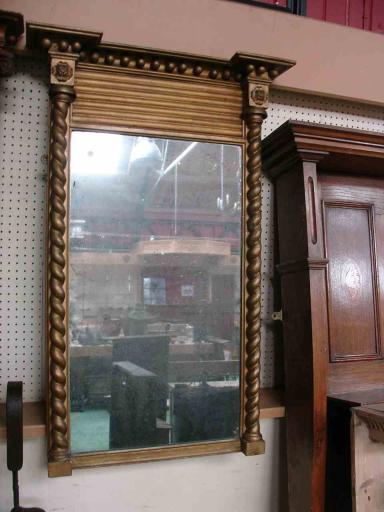
19thC gilt mirror with spiral column, sold £231 (est £100)

Pair of panelled pine doors from Redgrave Hall orangery c1760 by Henry Holland under Capability Brown for Rowland Holt, each 1.08m wide by 3.78m high, sold £220 (est £250)
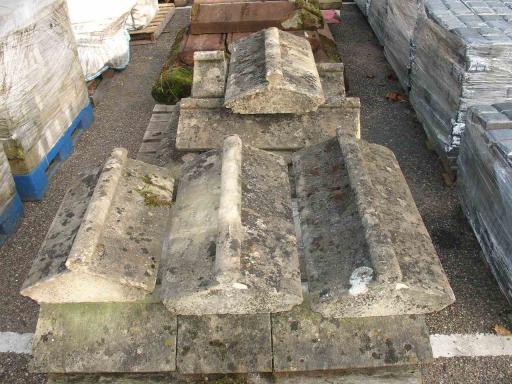
14ins roll ridge stone coping, sold £300 (est £300)
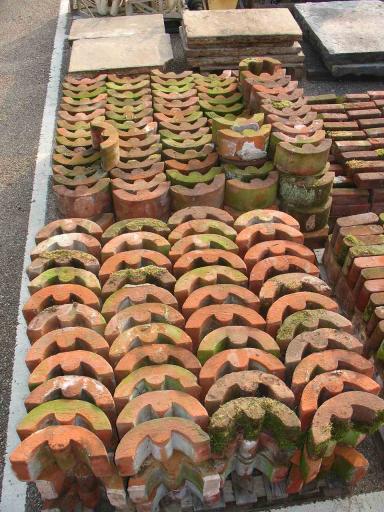
Old brick shapes from Brome Hall, Suffolk, sold £670 (est £200)
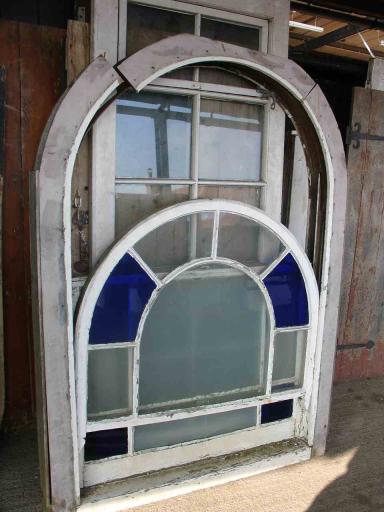
Arched top pine sash window with four blue glass panes
, sold £253 (est £150)


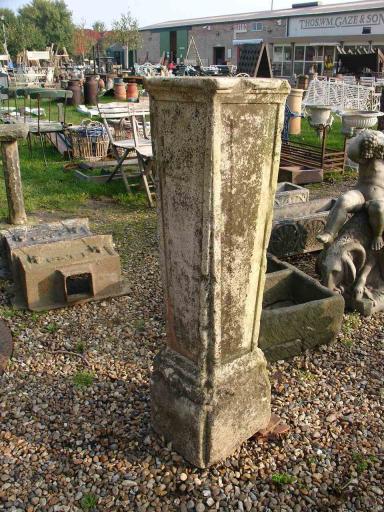
A Portland stone sundial base tapered panels on square base, the top 13ins square, sold £620 (est £300)

TOP LOT: a pair of compo lions couchant on plinths, sold £1,320 (est £1,200)
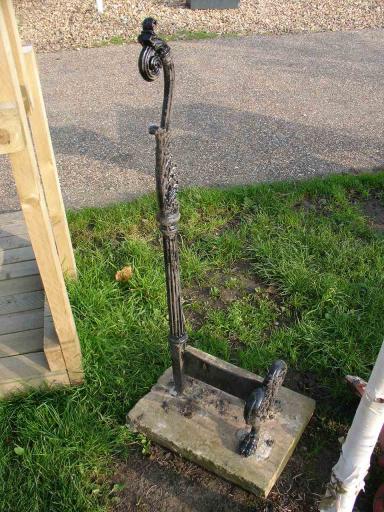
A cast iron boot scraper with decorative support set on a stone slab, sold £264 (est £150)

Six-sided steel tree seat, sold £440 (est £300)
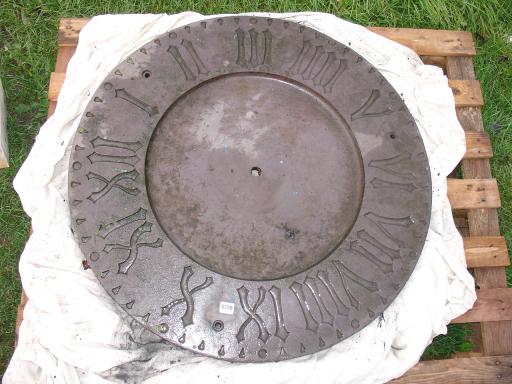
Late 19thC slate clock face 3ft dia 2ins thick, Roman numerals incised, minutes marked, sold £464 (est £400)
Diss, Norfolk UK - Site

Wednesday, July 26, 2006

Theft: Stained glass stolen

Leicestershire UK - A STAINED glass window believed to be about 600 years old was stolen from a church in Cranoe last week. Thieves removed the window from a c1400 stone tower at St Michael and All Angels Church in Church Hall Lane. Police believe it may have been stolen to be sold at an architectural salvage yard. The theft happened last Thursday or Friday and the diamond-patterned leaded glass was yellow, faded red and blue in colour. In the centre was a pattern resembling either a rose, flower or coat of arms. The Rev Elizabeth Sewell, the rural dean for the Anglican church in Harborough, said, "The news has been met with a degree of surprise, sorrow and sadness because village churches are really important to their community." Inspector Mick Norman, head of Harborough police, said, "It was carefully and professionally removed from the church. No fragments were left behind. It is the first time I have heard of this in my 32 years of policing. Unfortunately we have had a number of church break-ins over the last 12 months. We would ask anybody who lives in the vicinity of rural churches to keep an eye out and do not be reluctant to report anything suspicious. We are asking for public support – this was a mean crime." Church council member Vivien Hall said, "How can they have the gall to take out a whole stained glass window? Villagers are saying it was probably stolen to order." People with information can call PCSO 6526 Martin Doyle on 0116 2222222.

25 July 2006

No crime ref number, ilustration or sizes were given. No theft alert has been received.

Saturday, June 10, 2006

SalvoFAIR: Events and workshops


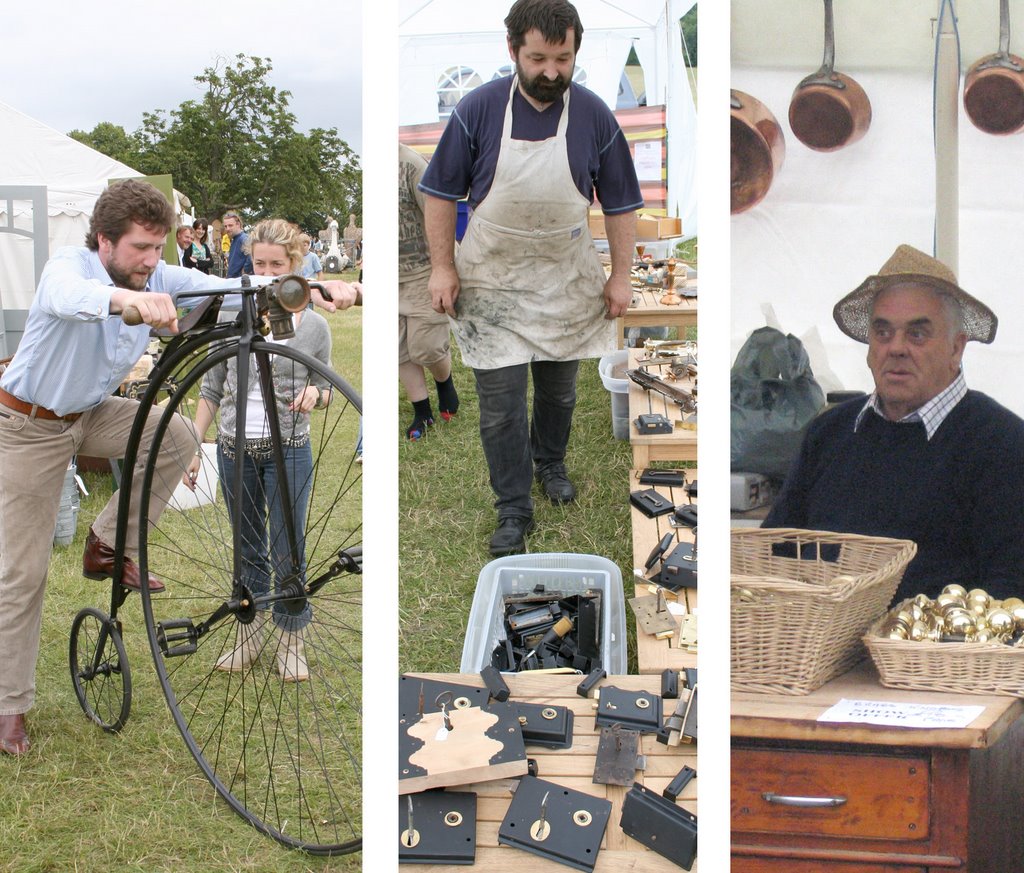
Photo: At Salvo 2005 Simon Kirby of Thomas Crapper & Co gave penny farthing rides, Michael Brown of Lock Restoration Co made antique keys while-u-wait, and Ronnie Wootton of MDS Ltd looked implacable as the world reflex champion. This year there will be more talks, and both Simon and Ronnie are prepared to take on all-comers [Photo 2005 © Salvo


Hertfordshire, UK - This year's Salvo Fair at Knebworth will include workshops, demonstrations and talks by the trade. Here are some examples:

Sanitaryware by Norman Cockroft of Alscot Bathrooms on the stand of Thomas Crapper & Co - How to clean stained baths bogs and basins, and when to call in the professionals.

Old cast iron radiators by Andy Triplow of the Old Radiator Company, Kent - How to clean them, test them and adapt them to modern heating systems.

Old English Rose & Paul kitchens by Tom Donaldson of Source, Somerset - Making 1950's aluminium kitchens fit for the modern home.

Antique keys and locks by Michael Brown of Lock Restoration Co, Strathclyde - How locks work, maintaining your old locks, repairs and keymaking.

Stained glass and leaded lights by Edgar Phillips of the Stained Glass Group, West Midlands - How to seal leaky windows, painting and firing, making hangers 'while-u-wait'.

Penny Farthing racing by Simon Kirby of Thomas Crapper & Co, Warwickshire - Mr. Kirby will take on all-comers. Probably late afternoon when the field is quieter. Contenders must bring their own penny farthing.

Traditional beam hewing by Wocko The Woodman of Knebworth - Slow but steady oak and chestnut beam hewing workshops, lasting all day between well-earned rests.

Reflex Reaction Challenge by Ronnie Wootton of MDS Ltd, West Midlands - Mr. Wootton, World Champion, who beat the Parachute Regiment at Malvern Show, will take on all-comers.

The Square Mile Project by James Rylands of Sotheby's on the stand of Extreme Architecture from Kent - The successful sale of the Baltic Exchange and other buildings like it is vital if more is to be saved. Dennis Buggins of Extreme Architecture will be there and is bringing parts of these buildings. Overseas and top-end dealers are welcome to the talk on Friday morning, and all construction professionals to the talk on Friday afternoon.

If you are planning to have a stand at the fair and have an idea for an event please contact Thornton Kay of Salvo. Tel 020 8400 6222. See the Salvo Fair web site.

Featured

Drummond Shaw interviewed in 2008

Hindhead, Surrey UK - DRUMMOND Shaw of Drummonds Architectural is interviewed by Thornton Kay of Salvo in the back yard of his Hindhead, Su...