Roslin, Midlothian Scotland
Builders renovating the 600-year-old Rosslyn Chapel, which was made famous in The Da Vinci Code, the Holy Grail and the Knights Templar, has thrown up another unfathomable puzzle: what lies behind the secret of the bees?
The discovery was made when two pinnacles, which had been made unstable by nesting jackdaws, had to be taken down stone by stone and rebuilt. At this time builders discovered two beehives carved within the stonework of the roof, these are thought to be the first man-made stone hives ever found. Allan Gilmour, from Hunter & Clark stonemasons, the main contractors on the chapel, said: “I’ve never heard of man-made stone beehives. What I have seen is bees creating hives in stone. When we restored the Irvine Town House we found that bees had burrowed into the sandstone and created honeycombs. They had weakened the stone. Maybe at Rosslyn the monks had the same problem in the past and created the hive as a sanctuary.” It is hoped the bees will return once the renovation works are complete.
Several unusual findings have been made during the project, including two skeletons.
BBC News
Showing posts with label reclaimed roofing. Show all posts
Showing posts with label reclaimed roofing. Show all posts
Monday, April 12, 2010

Wednesday, January 07, 2009
The increasing problem of metal theft
At a time of high global demand for raw materials, thieves are targeting many types of metal, typically lead and copper but also increasingly steel. Whilst roofs are the most likely targets, particularly on churches, other sources such as rainwater goods, lightning conductors and statues in the grounds are all at risk.
By the end of 2007, Ecclesiastical, the main insurer of churches, reported claims of over ten million Pounds. Lead sheet was the main target, but a significant proportion of this cost was making good damage caused by the thieves and the subsequent ingress of water. English Heritage believes that 'the dramatic increase in theft has come about because of spiraling prices caused by worldwide demand for lead-acid batteries, both for vehicles and UPS (uninterrupted power supplies) and more recently because of speculator activity this rising market price has attracted. Significant amounts of lead have been stock-piled and kept from the market to encourage prices to rise. Prices started to fall by the start of 2008 as new sources of supply opened up.'
English Heritage has issued specific guidance on metal theft in view of the intensification of the problem in recent months, particularly on lead roofs on churches. The guidance highlights the importance of prevention and the need to use a combination of security measures to deter thieves. Many of the options suggested are low cost but effective measures like locking gates to prevent vehicles getting close, preventing easy access to roofs such as removing water butts and waste bins, applying anti-climb paint to drain pipes and roof guttering, and erecting prominent warning signs.
[Salvo would encourage anyone who has had lead roofing or any other antique or architectural item stolen to raise a Salvo Theft alert. These are charged at 2p per day and are viewed by the thousands of people who look at SalvoWEB everyday.]
English Heritage
Salvo Theft Alerts
By the end of 2007, Ecclesiastical, the main insurer of churches, reported claims of over ten million Pounds. Lead sheet was the main target, but a significant proportion of this cost was making good damage caused by the thieves and the subsequent ingress of water. English Heritage believes that 'the dramatic increase in theft has come about because of spiraling prices caused by worldwide demand for lead-acid batteries, both for vehicles and UPS (uninterrupted power supplies) and more recently because of speculator activity this rising market price has attracted. Significant amounts of lead have been stock-piled and kept from the market to encourage prices to rise. Prices started to fall by the start of 2008 as new sources of supply opened up.'
English Heritage has issued specific guidance on metal theft in view of the intensification of the problem in recent months, particularly on lead roofs on churches. The guidance highlights the importance of prevention and the need to use a combination of security measures to deter thieves. Many of the options suggested are low cost but effective measures like locking gates to prevent vehicles getting close, preventing easy access to roofs such as removing water butts and waste bins, applying anti-climb paint to drain pipes and roof guttering, and erecting prominent warning signs.
[Salvo would encourage anyone who has had lead roofing or any other antique or architectural item stolen to raise a Salvo Theft alert. These are charged at 2p per day and are viewed by the thousands of people who look at SalvoWEB everyday.]
English Heritage
Salvo Theft Alerts
Tuesday, December 09, 2008
BigREc Survey shows predicted decline in reuse between 1998 and 2007

London UK - THE report on the BigREc 2 Survey was launched in St Pancras, London last Thursday 4th December 2008 with presentations and talks by Gilli Hobbs and Katherine Adams of BRE, Thornton Kay of Salvo and Steve Tomlin of Masco.
The report had been commissioned by BRE in 2006 and was carried out in 2006 – 2007. The results showed that, overall, the reclaimed part of the reclamation trade had declined since 1998, although some sectors of the trade, reclaimed bricks and architectural woodwork for example, had increased.
Anecdotal evidence that the government push for recycling, spearheaded by WRAP, had diverted materials away from reuse and towards crushing and chipping, seemed to be confirmed by the survey, with total volumes down from 2.96m tonnes in 1998 to 2.23m in 2007. Employment was also down from 39,000 in 1998 to 25,800 in 2007.
The BigREc survey was in two parts: Yellow Postcards and the main BigREc survey questionnaires comprising 19 material sectors ranging from salvaged concrete to antique bathrooms
2,043 Yellow Postcards were sent out of which 1,900 were valid, and 180 were returned (compared to 1200 sent out of which 288 were returned in 1998). These gave an indication of the total size of the market, the type of business and sales turnover of each respondent.
323 BigREc main survey questionnaires were sent out of which 36 were completed (88 completed in 1998) comprising of a 28 page booklet with 235 questions in total. The survey gave detailed info on volumes, stocks, suppliers, customers, distances goods travel, employment and standards of supply.
The Yellow Postcards and BigREc Survey were two separate surveys which corroborated each other to an extent.
It is a long job answering 235 questions and after the failure of the BigREc survey of 1998 to make any impact on policy (in fact government policy moved against reuse after the survey was published in 2000) unsurprisingly there was less enthusiasm for completing the survey this time.
The Yellow Postcards went into a draw for a free Salvo mag subscription worth £50 (won by Anglia Building Supplies in Essex) and the BigREc main survey went into a draw for a free stand at Salvo Fair worth up to £750 (won by David Nightingale of 3A Roofing in Suffolk).
Nine businesses completed both surveys in 1998 and 2007 – it would have been eleven but two have since gone completely out of salvage and into new manufacture. Accuracy is an issue with this survey, comparative shifts are more reliable than absolute figures.
The Yellow Postcard and BigREc 2 survey was undertaken by Thornton Kay of Salvo Llp.
Construction Resources Waste Platform BigREc Survey Report 2008
Thursday, February 08, 2007
Wiltshire yards asked to look out for stolen Cotswold stone roof tile
Melksham, Wiltshire UK - Following a recent increase in the theft of antique stone roof tiles and traditional stoneware, Wiltshire Police are asking for assistance from the public, and also offering advice on how to improve the security of such items. Tiles have been stolen from the roofs of remote farms and outbuildings, and heavy stone troughs and staddle stones, once a common sight in villages across rural Wiltshire, have also been taken.
There are a number of methods that can be used to property mark stoneware, to improve their security and to increase the chances of successful recovery in the event of a theft: External masonry paint can be applied to the surface of the stone
It is possible to create a free online portfolio of your valuables, which includes storing images, vital statistics, and product details of the stoneware. Police forces can then use the online facility as a method to recover stolen property. For further information visit the 'My Things' website. A further method, which has been used extensively in the Cotswolds and North Wiltshire, is 'SmartWater'. It is a “Secure by Design” approved product and therefore approved by the Association of Chief Police Officers. The solution can be used to mark roof tiles, flagstones, staddle stones and traditional stone troughs with the invisible, DNA-like, ‘forensic fingerprint’.
This fingerprint is unique to a single address, the details of which are kept on a secure database that can be accessed by police in the event of recovered stolen property being identified as marked with 'smartwater'. An annual licence can be gained through 'SmartWater', who supply the solution, applicator and warning stickers. For further information visit the 'SmartWater' website.
Mark Abbott, Neighbourhood Watch and Crime Reduction Officer, said, "I have used this property marking system to protect stone roof tiles. I simply dabbed SmartWater into the difficult to reach areas of the stone tiles. SmartWater only require a tiny speck to identify the property if it has been stolen. The owners details will be stored on a secure database to ensure positive identification. I also recommend the FREE online portfolio, on which you can store images, vital stats, and product details of your valuable stoneware. It is a useful tool for police forces across the country, who can then use the online facility to help to trace the owners of any recovered stolen property."
Wiltshire Police believe the majority of stone items stolen from the area remain locally, possibly to be used again in building projects. Consequently, builders and reclamation yards are being asked to thoroughly check the source of any stone items they may buy, or that are in their possession. The public are asked to contact Wiltshire police if they see anyone acting suspiciously, and to provide details of the vehicle and any possible descriptions of the individuals, on 0845 408 7000, or alternatively Crimestoppers, where information can be left anonymously, on 0800 555111.
Wiltshire Police Press Release
There are a number of methods that can be used to property mark stoneware, to improve their security and to increase the chances of successful recovery in the event of a theft: External masonry paint can be applied to the surface of the stone
It is possible to create a free online portfolio of your valuables, which includes storing images, vital statistics, and product details of the stoneware. Police forces can then use the online facility as a method to recover stolen property. For further information visit the 'My Things' website. A further method, which has been used extensively in the Cotswolds and North Wiltshire, is 'SmartWater'. It is a “Secure by Design” approved product and therefore approved by the Association of Chief Police Officers. The solution can be used to mark roof tiles, flagstones, staddle stones and traditional stone troughs with the invisible, DNA-like, ‘forensic fingerprint’.
This fingerprint is unique to a single address, the details of which are kept on a secure database that can be accessed by police in the event of recovered stolen property being identified as marked with 'smartwater'. An annual licence can be gained through 'SmartWater', who supply the solution, applicator and warning stickers. For further information visit the 'SmartWater' website.
Mark Abbott, Neighbourhood Watch and Crime Reduction Officer, said, "I have used this property marking system to protect stone roof tiles. I simply dabbed SmartWater into the difficult to reach areas of the stone tiles. SmartWater only require a tiny speck to identify the property if it has been stolen. The owners details will be stored on a secure database to ensure positive identification. I also recommend the FREE online portfolio, on which you can store images, vital stats, and product details of your valuable stoneware. It is a useful tool for police forces across the country, who can then use the online facility to help to trace the owners of any recovered stolen property."
Wiltshire Police believe the majority of stone items stolen from the area remain locally, possibly to be used again in building projects. Consequently, builders and reclamation yards are being asked to thoroughly check the source of any stone items they may buy, or that are in their possession. The public are asked to contact Wiltshire police if they see anyone acting suspiciously, and to provide details of the vehicle and any possible descriptions of the individuals, on 0845 408 7000, or alternatively Crimestoppers, where information can be left anonymously, on 0800 555111.
Wiltshire Police Press Release
Friday, November 03, 2006
Unusual ridge sought
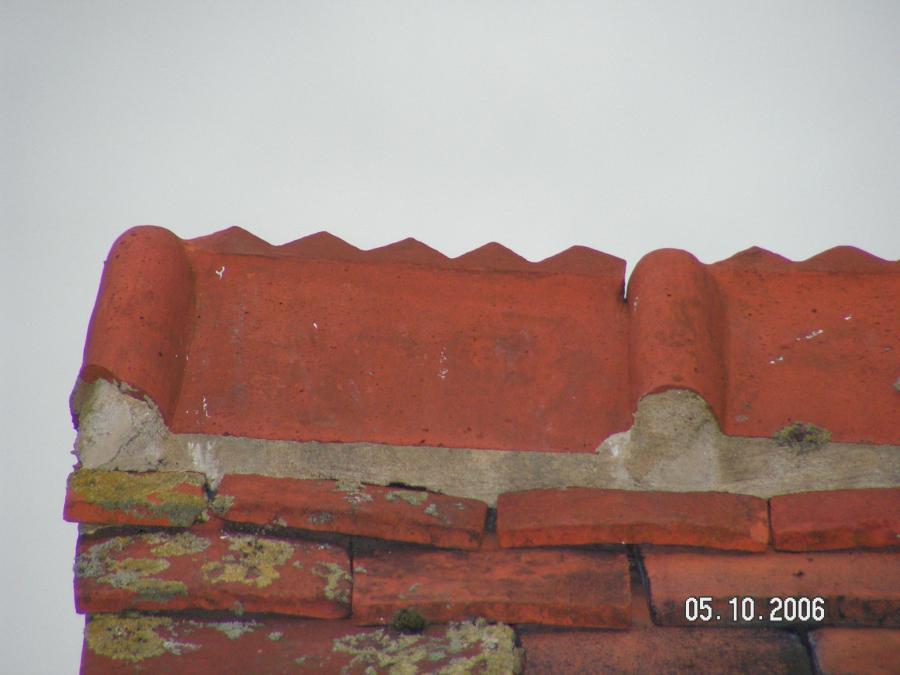 Single roman ridge with a coxcomb. [Photo Bakers
Danbury, Essex UK - BAKERS of Danbury, a building company founded by William Baker in 1878, is looking for some very unusual hog's back red clay ridge. We would describe it as a single roman with a coxcomb. Bakers ad says it is 'possibly French, hog back type with with zigzag detail on top with a roman roll at the end which laps over the next tile'. We have never seen a ridge like it. Bakers' photo shows the ridge sitting on what look like 10 by 6 plain tiles, which would make each piece of ridge roughly 12 or 13 inches long. If you can help, please phone Bakers on 01245 225876 or contact Salvo on 020 8400 6222. Bakers want ad on SalvoWEB
Monday, May 22, 2006
East London slates go west on demo job
The slates look as if they could be reclaimed. Does no-one know they are worth a pound each, don't they care, or have they been told to salvage nothing for reuse?
Subscribe to:
Posts (Atom)
Featured
Drummond Shaw interviewed in 2008
Hindhead, Surrey UK - DRUMMOND Shaw of Drummonds Architectural is interviewed by Thornton Kay of Salvo in the back yard of his Hindhead, Su...

-
 Above: the Tree-Trunk garden house Piet Hein Eek specialises in making furniture from waste material from the industry and nature. He also u...
 -
Richard Billington an antique fireplace and mantelpiece expert working for Westland London gives advice on how to care for antique fireplace...
-
Milton Common, Oxfordshire UK - LONDON Architectural Salvage & Supply Co Ltd, aka Lassco, having spent the last few years repositi...